
India is one of the oldest civilisations in the world, and its culture, traditions, and architecture are admired across the globe. Many of these masterpieces are recognised by UNESCO as World Heritage Sites. These sites are chosen because they represent extraordinary cultural value, architectural brilliance, natural beauty, or historical importance.
As of now, India has 42 UNESCO World Heritage Sites, making it one of the countries with the highest number of protected heritage locations. These sites are spread across the nation and attract millions of travellers every year.
In this article, we will explore the Top 10 World Heritage Sites in India. Each point is explained in detail, with travel tips, history, and important highlights to help you plan your journey.
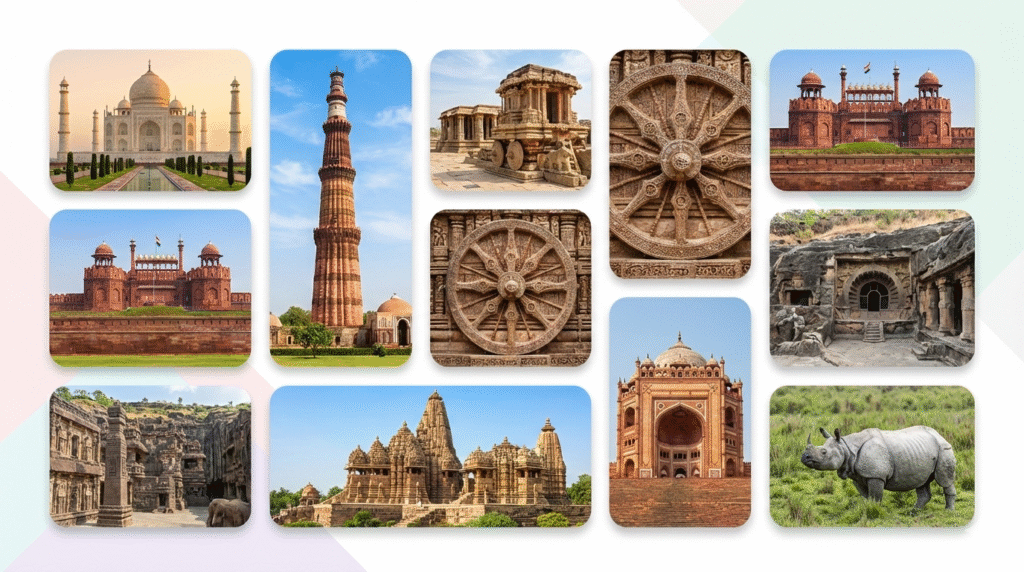
1. Taj Mahal, Agra
The Taj Mahal is not just India’s most iconic monument—it is one of the Seven Wonders of the World. Built by Mughal Emperor Shah Jahan in memory of his beloved wife Mumtaz Mahal, the Taj Mahal symbolises eternal love. Completed in 1653, this masterpiece is made entirely of white marble, which changes shades depending on sunlight.
Why It’s Special
- Perfect symmetry in design
- Intricate marble carvings and calligraphy
- One of the world’s greatest examples of Mughal architecture
- A symbol of love admired globally
Travel Tips
- Best time to visit: Sunrise (less crowd, beautiful lighting)
- Book tickets online to avoid long queues
- Closed on Fridays
The Taj Mahal is more than a monument. It feels like a dream crafted in stone—a place where art, history, and emotions merge beautifully.
2. Agra Fort, Uttar Pradesh
Located only a few kilometres from the Taj Mahal, Agra Fort is another UNESCO World Heritage Site that showcases the grandeur of Mughal history. Built in 1573 by Emperor Akbar, the fort served as the main residence of several Mughal rulers.
Why It’s Special
- Houses beautiful palaces like Jahangiri Mahal, Khas Mahal, Diwan-i-Khas
- Made of massive red sandstone walls
- Historical site where Shah Jahan was imprisoned by Aurangzeb
- Offers a distant view of the Taj Mahal
Travel Tips
- Best season: October–March
- Wear comfortable shoes—there is a lot to walk
- Hire a guide to understand Mughal history better
Agra Fort gives visitors a glimpse of royal life, military planning, and India’s medieval architecture.
3. Qutub Minar, Delhi
Standing tall at 73 metres, the Qutub Minar is the tallest brick minaret in the world. Its construction was started by Qutb-ud-din Aibak in 1193 and completed by Iltutmish.
Why It’s Special
- Beautiful Indo-Islamic architecture
- Quranic verses carved on the tower
- Located inside the Qutub Complex, which includes the Iron Pillar (that does not rust)
Travel Tips
- Ideal time: morning or late afternoon
- Avoid weekends if you want a peaceful visit
The Qutub Minar is a must-visit for anyone who loves architecture, ancient craftsmanship, or history.
4. Red Fort Complex, Delhi
The Red Fort, built by Emperor Shah Jahan in 1648, is a symbol of India’s freedom. Every year on 15 August, India’s Prime Minister addresses the nation from the fort’s ramparts.
Why It’s Special
- Massive red sandstone structure
- Fine Mughal artwork
- Important landmark of India’s independence movement
- Light & Sound Show in the evening
Travel Tips
- Visit during weekdays to avoid heavy crowds
- Ideal season: October–March
Walking through the Red Fort feels like travelling back in time to the era of emperors and royal courts.
5. Humayun’s Tomb, Delhi
Built in 1570 by Humayun’s wife, Empress Bega Begum, this is the first garden-tomb in the Indian subcontinent. It inspired the architecture of later Mughal monuments, including the Taj Mahal.
Why It’s Special
- Surrounded by Persian-style gardens
- Perfect symmetry
- Intricate red sandstone and marble design
Travel Tips
- Best time: Morning hours
- Combine your visit with nearby Nizamuddin Dargah for a cultural experience
Humayun’s Tomb is peaceful, elegant, and a masterpiece of Mughal architecture.
6. Konark Sun Temple, Odisha
The Konark Sun Temple, built in the 13th century, is dedicated to the Sun God. The temple is designed like a giant stone chariot drawn by seven horses.
Why It’s Special
- 24 intricately carved wheels and massive horses
- Masterpiece of Kalinga architecture
- Mythology, engineering, and art blend beautifully
Travel Tips
- Best season: November–February
- Visit during the Konark Dance Festival for cultural performances
Even though the temple is partially ruined, its carvings and concept still amaze visitors.
7. Khajuraho Group of Monuments, Madhya Pradesh
Built between 950–1050 CE by the Chandela dynasty, the Khajuraho Temples are famous for their stunning sculptures depicting life, spirituality, love, and divinity.
Why It’s Special
- Nagara-style temple architecture
- Over 20 surviving temples with detailed carvings
- Symbol of artistic freedom in ancient India
Travel Tips
- Best time: October–March
- Attend the Khajuraho Dance Festival
Khajuraho is not just about sculptures. It represents India’s openness toward art, emotions, and creativity.
8. Hampi, Karnataka
Once the capital of the Vijayanagara Empire, Hampi is a vast open-air museum of ruins, temples, and royal structures. The landscape is filled with huge boulders, making it a favourite for travellers and photographers.
Why It’s Special
- Over 500 ancient monuments
- Virupaksha Temple, Vittala Temple, Stone Chariot
- Lost city that still reflects the glory of its empire
Travel Tips
- Best time: November–February
- Rent a bicycle or scooter for easy exploration
Hampi feels magical—like stepping into a historic movie set where every stone tells a story.
9. Jaipur (Pink City), Rajasthan
In 2019, Jaipur’s historic walled city was declared a UNESCO World Heritage Site. Known as the Pink City, Jaipur is famous for its palaces, forts, markets, food, and traditional architecture.
Why It’s Special
- Unique urban planning
- Beautiful palaces like City Palace, Hawa Mahal
- Amber Fort and Jantar Mantar (also UNESCO sites)
- Rich culture, colours, and royal history
Travel Tips
- Best season: October–March
- Explore local markets like Johari Bazaar
Jaipur blends heritage with culture in the most colourful way.
10. Kaziranga National Park, Assam
Kaziranga is a natural World Heritage Site and home to the world’s largest population of the one-horned rhinoceros. Spread across the floodplains of the Brahmaputra River, it is one of India’s most biodiverse wildlife reserves.
Why It’s Special
- More than 2,600 one-horned rhinos
- Dense forests, wetlands, and grasslands
- Tigers, elephants, wild buffaloes, and exotic birds
Travel Tips
- Best time: November–April
- Jeep and elephant safaris available
- Book safaris in advance during peak season
Kaziranga is a paradise for nature lovers and wildlife photographers.
Why India Has So Many World Heritage Sites
India has thousands of years of history and countless empires, kingdoms, and cultures. Each contributed something unique—temples, forts, cities, art, architecture, and traditions.
UNESCO selects sites based on:
- Cultural significance
- Architectural brilliance
- Natural importance
- Universal value to humanity
India’s diversity makes it one of the richest countries in terms of heritage.
Travel Tips for Exploring World Heritage Sites in India
Here are some simple tips to make your trips smooth and enjoyable:
✔ Book your tickets online
Most popular monuments now have online tickets. This saves time.
✔ Visit early morning
Avoid crowds and enjoy calm weather.
✔ Respect rules
Do not touch carvings, do not litter, and follow photography rules.
✔ Hire a guide
A local guide adds much more value by explaining hidden stories.
✔ Carry essentials
Water, sunscreen, sunglasses, and comfortable footwear are must-haves.
Conclusion of Top 10 World Heritage Sites in India
India’s World Heritage Sites showcase the country’s glorious past, diverse culture, and natural beauty. From the marble magic of the Taj Mahal to the ancient ruins of Hampi and the wildlife of Kaziranga, each site is a chapter of India’s incredible story.
Visiting these Top 10 World Heritage Sites in India is like travelling through time—discovering stories, art, architecture, and heritage that have shaped our world.